Welcome
Climate change is affecting water resources through flooding, groundwater depletion, cryosphere change, and sea-level rise. My research seeks to improve our ability to understand, predict, and model hydrologic processes in complex porous environments, with implications for water security, climate resilience, and risk mitigation.
I develop observation guided theoretical, numerical, and data-driven models to investigate groundwater flow, critical zone processes, multiphase transport, and environmental change across Earth and planetary systems. A central goal of my work is to bridge high-fidelity process-based simulations with computationally scalable predictive frameworks, enabling physically grounded hydrologic predictions from local to global scales.
In terrestrial hydrology, I study variably saturated flow in heterogeneous soils, integrated groundwater–surface water systems, and hydrology across scales. In the cryosphere, I investigate evolution, densification, and meltwater percolation in Greenaland firn (compacted snow), supported through collaborations with the University of Texas Institute for Geophysics (UTIG), the NASA Jet Propulsion Laboratory (JPL), NASA Goddard Space Flight Center.
My work also extends hydrologic theory to planetary environments as water is crucial for search for life. I study groundwater recharge, infiltration, and hydrothermal systems on early Mars, as well as melt migration through the ice shells of ocean worlds, through active collaborations with the European Space Agency (ESA), NASA, and the University of Texas at Austin. More broadly, I am interested in developing observation-guided hydrologic theories and computational tools that integrate reduced-order modeling, high-performance computing, and scientific machine learning and inform current/future astrobiology missions.
ParFlow-Community Land Model simulation outputs at Little Washita Watershed, ~30 km SMAP-grid scale (Shadab, Jadallah and Maxwell, under review)
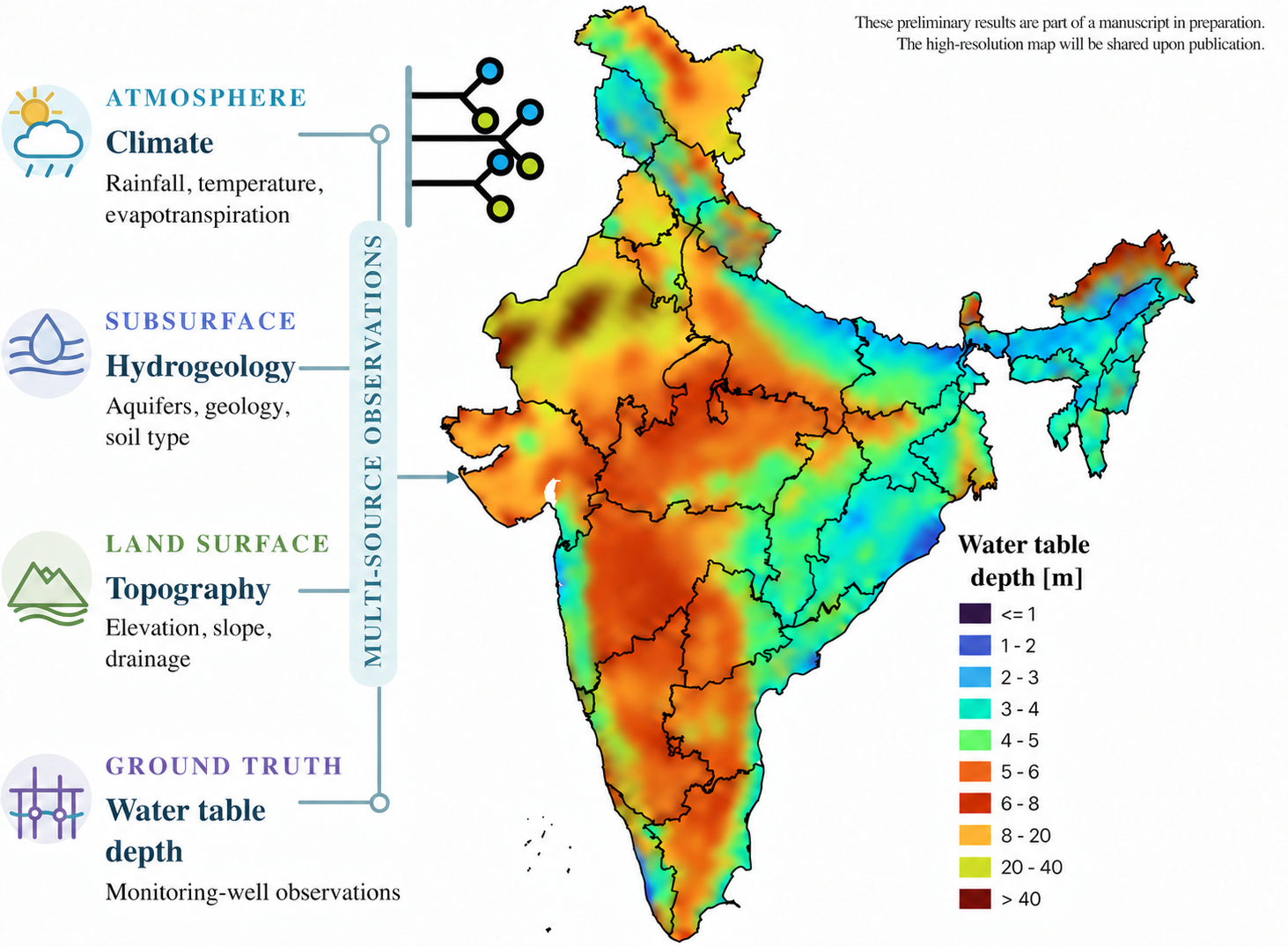
High-resolution mapping of water-table depth across India using a random forest model (Shadab et al., manuscript in preparation)
HydroFirn simulation: Multidimensional meltwater infiltration and firn evolution at Dye-2 site in Greenland showing top - saturation, temperature, mid - porosity and bottom - classification (black - grid, red - fully saturated regions, blue - impermeable ice layers) (Shadab et al., 2026)
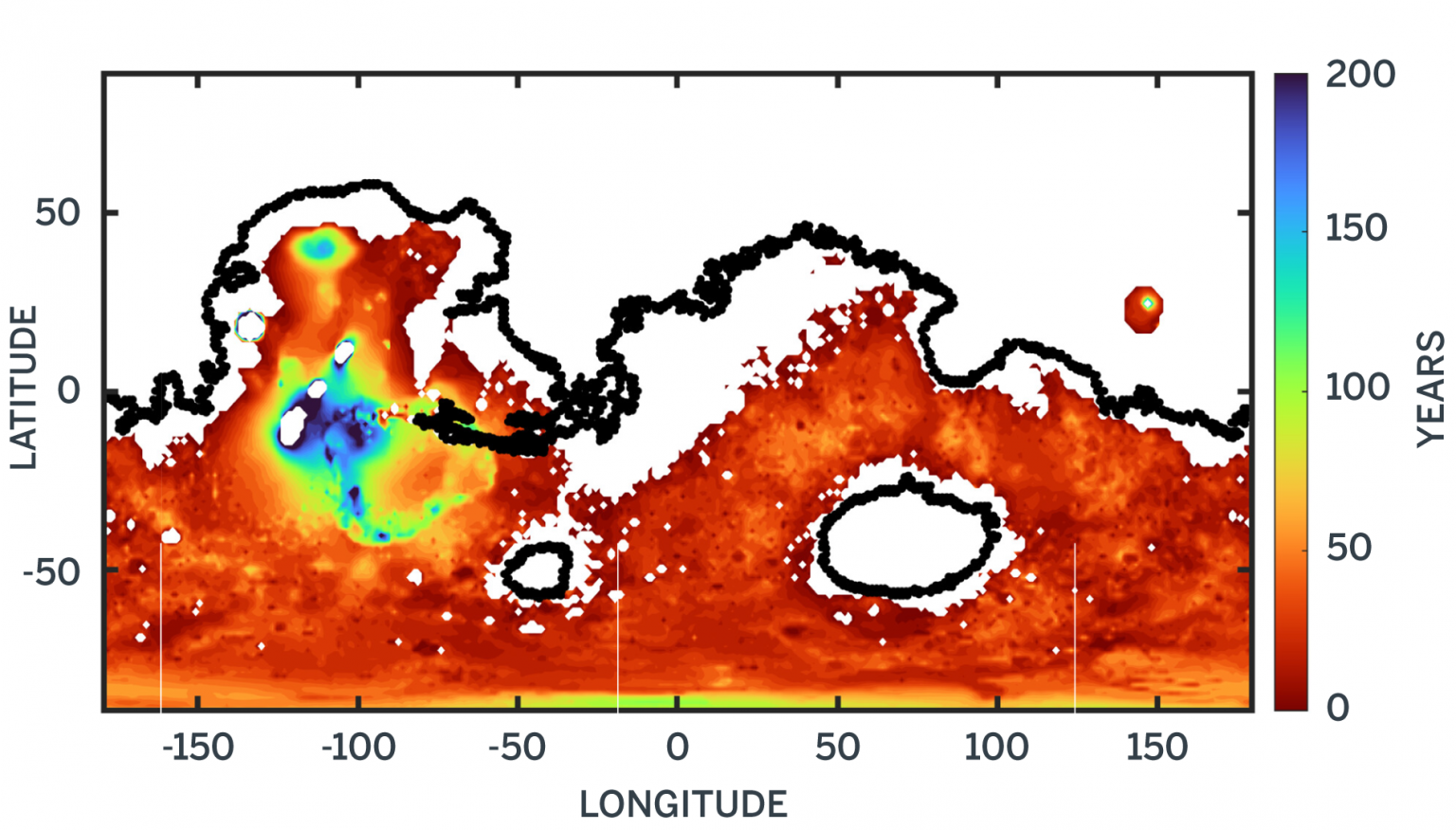
Time to infiltrate from surface to deep crustal aquifer on early Mars (Shadab et al., 2025)
About me
I am a Future Faculty in the Physical Sciences Postdoctoral Fellow at Princeton University, where I work with Professor Reed Maxwell on large-scale groundwater and integrated hydrologic modeling.
I earned my M.S. and Ph.D. in Computational Science, Engineering, and Mathematics from the University of Texas at Austin under the supervision of Professor Marc Hesse. Prior to that, I was a Visiting Graduate Student Researcher at the MIT Fluids Laboratory, working with Professor Irmgard Bischofberger. I also hold an M.Phil. in Mechanical Engineering from the Hong Kong University of Science and Technology, where I worked with Professor Kun Xu.
Before Princeton, I collaborated closely with researchers at UT Austin and NASA JPL, and contributed to interdisciplinary efforts spanning hydrology, cryosphere science, and planetary environments.
Beyond research, I am actively involved in community-building and mentorship. I serve as Co-chair and DEI Lead of the US Association of Polar Early Career Scientists, and contribute on the boards of AGU Cryosphere Science Section and Hydrology (H3S) communities. My work focuses on fostering inclusive, collaborative, and interdisciplinary research environments in Earth and planetary sciences.

News
13 September, 2026The preprint of the US Based ECR Survey is out and is under review in Journal of Glaciology! (link)
8 September, 2026Science communication interview with PhyPsyFilm on the connection between Water and Life on Earth and Beyond is out (Youtube link, LinkedIn article).
14 August, 2026The preprint of work on Mars led by Eric Hiatt is out and is under revision in Nature Geoscience! (link)
15 July, 2026Selected from over 500 applicants for the 2026 Technical Short Course on InSAR Processing and Analysis (ISCE+) (certificate).
15 July, 2026Accepted with travel support to the Near-surface Geophysics Community Input Workshop.
7 May, 2026Selected to review Intergovernmental Panel on Climate Change Assessment Report 7 Working Group I First Order Draft (FOD) and Second Order Draft (SOD).
15 April, 2026Presenting the International Glaciological Society Global Seminar on firn hydrology (recording).
13 April, 2026HydroFirn - A numerical model for large-scale multidimensional firn hydrology is out (preprint, code)!
5 April, 2026Preprint on Modeling enhanced rock weathering for CO2 removal using method of characteristics is out and is under minor revision in American Journal of Science!
30 March, 2026Preprint on A vertically integrated model with phase change for aquifers in cold firn is out (all codes)!